
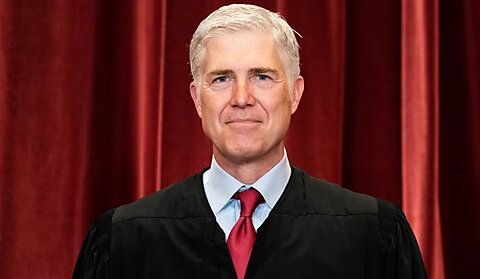
Justice Neil Gorsuch is facing the ire of the right (including President Trump) for joining the 6–3 majority that—correctly—ruled that President Trump cannot invoke the International Emergency Economic Powers Act (IEEPA) to impose a range of tariffs by executive fiat. This decision reversed the administration’s ability to impose tariffs on Canada, Mexico, and China based on a declared fentanyl emergency and much of the rest of the world based on a declared trade deficit emergency.
Although the administration is moving forward with its tariff plans through different legal statutes, including Sections 122 and 301 of the Trade Act of 1974, eliminating a president’s ability to unilaterally impose tariffs at whim against any country after declaring a national emergency is a victory that should be celebrated across the political spectrum.
Crucially, Gorsuch’s principled approach would prevent a future administration from unilaterally imposing arbitrary carbon tariffs upon declaring a climate emergency under the National Emergencies Act. This policy would have little chance of being authorized by Congress, based on an AP-NORC poll in 2025 that found that less than half of Americans support paying any amount to combat climate change.
Gorsuch was not the only conservative Justice to join the majority; he was not even the only Trump appointee, but the right has seen him as a reliable upholder of Trump’s policies and a block to Biden. However, in the newly decided case, Learning Resources, Inc. v. Trump, he proves himself an ardent defender of the separation of powers and of limits on executive overreach. Americans across the political spectrum should appreciate this principled approach in an era when bypassing a gridlocked Congress through executive fiat has become an increasingly common shortcut taken by recent administrations.
In 2015, the Environmental Protection Agency (EPA) used Section 111 of the Clean Air Act to set performance standards for emissions from specific sources to shift production from coal to renewable energy. Seven years later, the Court decided West Virginia v. EPA, which held that the executive exercised authority not explicitly granted by Congress, thereby violating the major questions doctrine. This was the first time the major questions doctrine emerged in a Supreme Court majority opinion.
In his concurring opinion in West Virginia v. EPA, Gorsuch explained the necessity of this doctrine, arguing it protects the clear separation of powers. “Agencies could churn out new laws more or less at whim. Intrusions on liberty would not be difficult and rare, but easy and profuse.” The decision served as a significant check on the executive, helping to ensure its reach did not outpace the authorities granted to it by Congress.
In 2023, the Court decided in Biden v. Nebraska that President Biden could not move forward with his student debt cancellation plan on the basis of the major questions doctrine. Citing West Virginia as precedent, the majority, which Gorsuch joined, stated, “…while the major questions ‘label’ may be relatively recent, it refers to ‘an identifiable body of law that has developed over a series of significant cases’ spanning decades.” Like West Virginia, the right celebrated this decision as a block on overstretched executive authority.
Fast-forward to 2026, Gorsuch cited the major questions doctrine dozens of times in his Learning Resources, Inc. v. Trump concurrence as a reason to block the tariffs, criticizing the court’s liberals for suddenly adopting “a more constrained approach” of its interpretation, while also criticizing the dissenters for the opposite—suddenly willing to grant the executive authority not clearly provided by Congress.
Credit to all Justices who sided with the majority, but it is Gorsuch’s 46-page concurrence that best encapsulates how the doctrine should be applied, which should earn him high praise from the right. In both 2022 and 2026, he has maintained ideological consistency and preserved the role of the doctrine as a key check on executive authority, a victory for conservatives—even if many would disagree now.
Consider politicians on the left who could exploit a weakened major questions doctrine to detrimental effect. In 2021, Representative Ocasio-Cortez and Senator Sanders introduced legislation that would not merely suggest but direct President Biden to declare a national emergency on climate change. A future administration supportive of this “climate mobilization” could capitalize on a weakened doctrine to bypass the legislative process entirely.
By citing broad authority in statutes like the IEEPA, the next administration could declare an emergency to justify a ban on crude oil exports (championed by Senator Sanders and others) or institute a pause or ban on exports of liquefied natural gas, as the Biden administration attempted to do. Climate tariffs are another clear threat under an expanded view of executive authority.
Gorsuch made his concerns clear when, during oral arguments, he pressed Solicitor General Sauer on whether, under the administration’s theory, a president could impose a 50 percent tariff on gasoline-powered cars and auto parts to “deal with the unusual and extraordinary threat from abroad of climate change.” Sauer responded, “It’s very likely that that could be done.”
Surprisingly, many on the political right did not see the outcome of Learning Resources as a victory, despite Sauer’s clear warning of what could come from a future administration if the Trump administration prevailed in this case. Over time, appreciation for Justice Gorsuch’s efforts to curtail arbitrary executive authority should grow. For now, his wisdom seems lost on the political right, which appears focused on short-term wins rather than the good of the Republic in the long term.
Gorsuch, along with the rest of the majority, has largely saved the American people from a future administration declaring a climate emergency and instituting measures like climate tariffs at the president’s sole discretion. His steadfast application of the major questions doctrine has been a much-needed check on executive authority regardless of administration, an honor not all his colleagues can claim. While the ruling drew the ire of the administration and much of the right, conservatives should appreciate the decision when it is used as precedent to block some of progressives’ most detrimental policies.
Cato research associate Michael Abi-Nader and Cato intern Wendy Zhang contributed to this article.