
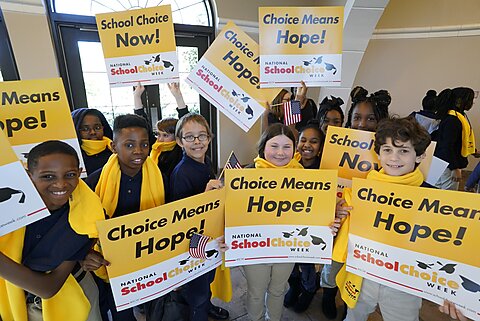
It’s National School Choice Week. But why do we have National School Choice Week and not National Grocery Store Choice Week or National Doctor Choice Week? Simple—education is the only sector that the government decided to take over and run this way.
Horace Mann, an activist from Massachusetts in the mid-1800s, is considered the father of our public school system. Imagine if, instead of education, he thought the government should ensure all children had food. Further, imagine if he had decided the way to ensure they had food was to have the government create and run local grocery stores that were funded by taxpayers. The food at these stores would be “free” for all children who lived within a certain radius. People could vote on how to run and stock the store. But anyone who disagreed was stuck with what the majority decided unless they could afford to pay twice—once for the taxes that supported the store and again to shop at another store.
Similarly, imagine if medical care was Mann’s primary concern and he had pushed for government-run, taxpayer-funded clinics that people were assigned to. People could go for “free,” but they would have little say in how they were run other than by voting for clinic board members every few years. If they wanted other care, they would have to pay twice.
These examples sound absurd—especially in 2025. But are they any more absurd than assigning children to schools based on where they live instead of their interests and needs? We don’t handle preschool or college that way. Only education for kids aged 5–17. Perhaps the reason we don’t use that method in any other area of life is that it’s absurd.
National School Choice Week exists to help people understand that different educational environments work better for different kids. School choice programs let a portion of state funding follow students to a variety of educational options. Some, such as vouchers and tax credit scholarships, can only be used for private school tuition. Others, such as education savings accounts, can be used for expenses such as tutoring, curricula, and services for children with special needs in addition to tuition.
There are now around 80 school choice programs on the books in 33 states plus Washington, DC, and Puerto Rico. EdChoice estimates that around 1.2 million students are currently using these programs this school year. That’s encouraging. But it’s a drop in the bucket when you consider there are 54 million American kids in that age and nearly 60 percent of parents say they would choose something other than their assigned school if they could.
Most school choice programs were initially targeted to specific populations, such as students with special needs, students assigned to low-performing schools, or children from lower-income families. But there’s a growing trend towards universal eligibility for these programs as people increasingly realize it’s fairer. Plus, universal eligibility can result in better, more stable programs because they have a wider base of supporters and a greater diversity of users. Only four states are truly universal currently, in terms of eligibility, usage, and funding, but many more are heading that way.
If the government is going to mandate education funding and attendance, school choice is crucial for individual freedom. Parents shouldn’t be mandated to send their children to a government-run school or be forced to pay twice—once in taxes and once in tuition—if they choose another option. School choice programs help right that wrong by giving parents access to education dollars to use at those other options.
Perhaps one day, when no child is limited to an assigned school, the idea of National School Choice Week will seem as absurd as National Grocery Store Choice Week.