
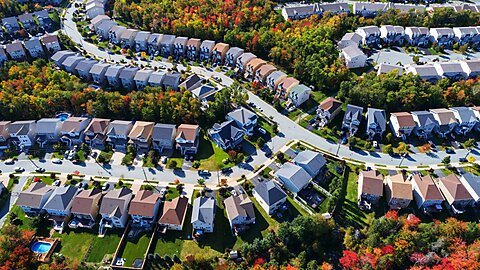
The California State Legislature continues to churn out reams of legislation to address the state’s homelessness crisis and housing shortage, with Governor Gavin Newsom signing over thirty relevant bills just last week. While many of the bills have good elements, e.g., lowering the barriers to new home construction, the whole exercise is underpinned by the notion that California can centrally plan its way to an “adequate” housing supply.
But central planning has been repeatedly tried and found to be wanting—most famously in the former Soviet Union where Josef Stalin implemented the first five-year plan in 1928. These detailed recipes for top-down economic management sometimes yielded apparent successes (for example, the rapid industrialization of the Soviet economy) but ultimately failed consumers and contributed to the economic weakness and unrest that ended the Soviet state.
As Nobel Laureate Friedrich A. von Hayek convincingly argued, central planning fails because the planners, even if well-intentioned, lack the knowledge necessary to efficiently allocate resources. That information lies within the heads of the millions of individuals participating in the economy and is best elicited through competition and the unfettered use of prices, which communicate consumer preferences.
But California’s political leaders have forgotten Hayek’s lesson. Just as socialist countries do with their five-year plans, California creates housing production goals at the state level and then pushes them down to regional and local governments. This top-down planning process often ignores local conditions and changes that occur during the planning cycle.
Consider the case of the San Francisco Bay Area. In June 2020, the state’s Department of Housing and Community Development (HCD) made its latest Regional Housing Needs Assessment (RHNA) for the nine-county area, instructing the Association of Bay Area Governments to add 441,176 housing units by December 31, 2030.
But the requirements analysis was based on pre-COVID-19 population projections when it was thought that coastal California’s population would continue its slow but steady growth. Instead, many people fled to inland California and to other states in pursuit of more space and a lower cost of living. While the HCD’s RHNA projection was based on an expected Bay Area population of 8.3 million at the end of 2030, state demographers now forecast 650,000 fewer residents at that time.
The HCD’s RHNA assessment also includes assumptions about the proportion of the population living in institutional settings and the number of residents living in each housing unit. Without updates to those assumptions, it is impossible to precisely determine what the Bay Area’s RHNA would be given current population forecasts. Assuming an unchanged institutional housing ratio of about 2 percent and persons per household remaining at 2.68, the Bay Area’s RHNA would fall from 441,176 to just over 203,000, or more than half.
Yet the state government, ABAG, counties, and cities grind along using the now outdated estimate. State authorities are pushing these stale RHNA housing production goals onto the 101 municipalities of the Bay Area and their counterparts elsewhere in the state, sometimes penalizing them for failing to comply.
By contrast, Texas is able to produce housing for a growing population at lower prices and with less homelessness, all without a state-led central housing plan. In 2023, Texas authorized 232,373 new private housing units or more than double the 111,760 approved in California.
One reason that Texas is more successful than California is that it generally permits developers to create new subdivisions in the exurbs of large metropolitan areas. This is anathema to California’s housing planners who want everyone to live near transit. The preferences of these planners run against those of the many young parents who want more space for their kids (as well as themselves) and who are willing to drive to work and other destinations. In California, by contrast, most land is excluded from residential development because it is under government stewardship or zoned for agricultural purposes only.
California progressives should be applauded for adopting a “Yes In My Back Yard” mentality. But now they must be challenged to take the next step: rather than micromanage the housing production process, they should be getting out of the way and allowing home builders and home buyers the flexibility needed to alleviate the state’s housing shortage.