
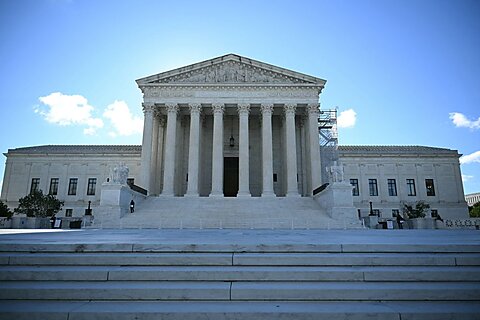
In Trump v. US, a majority of the Supreme Court has laid down an astonishingly broad view of presidential immunity from criminal prosecution over official actions, even those taken for heinous motives and with no show of justification. We should heed the warnings of dissenting Justice Sonia Sotomayor, joined by Elena Kagan and Ketanji Brown Jackson, who charge the majority with concocting an “atextual, ahistorical, and unjustifiable” array of immunities that will too often place above the law a president bent on criminal misuse of his powers of office.
Nowhere in the Constitution is there mention of executive immunity, which was a topic of peculiar interest to the Founders and Framers. Alexander Hamilton wrote in Federalist 69 that unlike the “king of Great Britain,” the chief executive of the United States would “be liable to prosecution and punishment in the ordinary course of law,” and in Federalist 77 named “subsequent prosecution in the common course of law,” in addition to impeachment, as checks on “abuse of the executive authority.”
Notwithstanding this history, it was probably foreordained that the court would find some degree of presidential immunity. The US Justice Department under administrations of both parties has long taken for granted an immunity of some dimension or other, and the current Department, former President Trump’s adversary here, did not retreat from that view in this case. Although the court had never had to rule on criminal immunity, a 5–4 majority in the 1982 case of Nixon v. Fitzgerald had recognized an immunity from civil claims, such as for wrongful dismissal, over official presidential actions.
However, the Fitzgerald Court explicitly recognized that immunity from criminal prosecution would raise entirely different issues because the public welfare is far more deeply implicated when a president commits a crime than when he may happen to commit, say, a tort.
The shock was not that the majority led by Chief Justice John Roberts recognized some zone of immunity, but that at one key decision point after another, it seized on any half-plausible ground (and some perhaps less than half-plausible) to expand both the formal and the practical scope of immunity. Here is an incomplete list:
For a range of actions exercising core executive authority, including conversations with subordinates such as the attorney general, pardons, and appointments, immunity is absolute, even if actions were taken for a corrupt purpose or as part of a conspiracy otherwise criminal.
Exercise of less-than-core executive authority is still immune, the majority writes, “unless the Government can show that applying a criminal prohibition to that act would pose no ‘dangers of intrusion on the authority and functions of the Executive Branch.’” The use of “no” rather than, say, “no more than minimal,” means that lawyers for a criminal ex-president need only establish a scintilla of danger of intrusion on executive function to defeat a prosecution over the gravest misuse of official power. If the court was making up this standard as it went along, why not make up a standard friendlier to public liberty?
Unofficial actions by a president, all agreed, are not immune. But how to define them? “In dividing official from unofficial conduct, courts may not inquire into the president’s motives,” the court declared. And yet motive and intent often make the difference in whether a course of action constitutes a crime—most especially by establishing the prerequisite of a guilty mind (mens rea). And motive and intent go to the core of whether a chief executive acted with presidential duties in mind, or in pursuit of, say, his interests as a candidate. It’s an arbitrary limitation that will derail otherwise well-grounded prosecutions.
The court then offers guidance on how to distinguish official from nonofficial conduct—but keeps suggesting that almost every kind of misconduct alleged of Donald Trump might count as an official action. Was it unofficial for Trump to lean on a Georgia official to “find” votes for him? Well, presidents in the course of their duties naturally speak to many government officials, so maybe yes, the majority seems to think. Was it unofficial—speech taken in his interests as a candidate, not as a chief executive—for Trump to harangue a crowd shortly before violence broke out at the Capitol? Well, presidents in the course of their duties give speeches all the time, so again, maybe yes. By this standard, what isn’t an official act?
Even if a prosecution somehow clears these hurdles, more hurdles lie ahead. The majority decreed that evidence relating to immune acts must not be allowed into evidence even if highly probative as to the commission of other crimes for which there is no immunity. (Justice Amy Coney Barrett declined to join this part of the opinion.) For good measure, the exclusion of communications with a president’s subordinates will often forestall the best way of establishing what happened.
Singly, these are instances of doubtful solicitude toward the Executive. Together, they combine into something more and worse. This is not what the Framers wanted. It is not what we should want either.