
When push comes to shove, can foreigners be counted on to help meet US national security needs? The answer, according to a former deputy undersecretary of defense for industrial policy, is yes. In fact, they might be more responsive than American firms. It’s a reality that should call into question some premises of US trade policy.
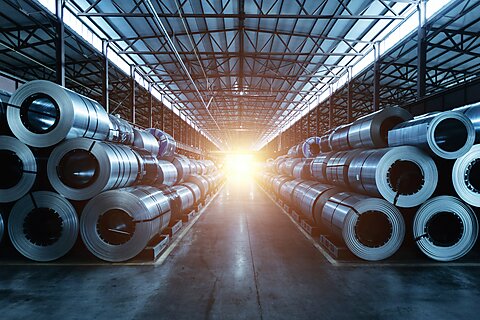
In an op‐ed last week, William C. Greenwalt recalls that during the Iraq and Afghanistan conflicts the US military had a pressing need to obtain specialized steel for its Mine‐Resistant Ambush Protected (MRAP) program. Thankfully, the US steel industry rose to the occasion, right? Not exactly. In Greenwalt’s telling, the industry—a beneficiary of protectionist measures including tariffs on steel imports and “Buy America” preferences—was not interested in supplying the Pentagon with the necessary materials.
Instead, the US military obtained steel from companies in Australia, Germany, Israel, and Sweden.
“When [the Department of Defense] urgently needed more steel, the US industry basically told Uncle Sam to pound sand,” Greenwalt writes. “Our allies then bent over backwards to help us, when our own industry would not.”
Greenwalt—now a nonresident senior fellow at the American Enterprise Institute—does mention that one US company, Oregon Steel, was an exception to this disinterest. The company, however, ran afoul of protectionist Buy America restrictions due to its use of crucial inputs from Mexico. That necessitated a waiver to obtain the needed materials—one that other US steel firms vigorously opposed. As he writes:
One US company did do something, and that was Oregon Steel. They had a process that could produce the quality of steel that the MRAPs needed but it would require the importation of steel ingot from Mexico to fuel their mills. This would require a waiver from Buy America restrictions that mandated that all steel DoD uses be not only produced, but smelted in the US. US steel industry lobbyists vehemently opposed any such waiver. DoD eventually granted the waiver, thereby increasing MRAP‐relevant steel production by 40 percent. The brutalist of ironies: The company was purchased by Russians in 2007. The irony that the Russians stepped up to protect our troops while US industry did not was probably not lost on the Kremlin.
As his experience shows, being an American firm—an increasingly nebulous term in this globalized world—does not ensure a company’s willingness to meet US national security requirements. Conversely, being foreign doesn’t necessarily mean a company is unreliable.
This should help inform US uses of trade protectionism. An oft‐invoked rationale for import barriers is that the US industry targeted for protection would otherwise become dangerously small or disappear. That, in turn, would lead to reliance on allegedly risky foreign suppliers with potentially dire consequences for the country’s defense.
Unsurprisingly, numerous industries employ such logic to their advantage, insisting they are not trying to pad their profits through run‐of‐the‐mill protectionism but looking out for the country’s national security. The steel industry certainly does it. The maritime industry too. Even supporters of sugar protectionism have gotten in on the act.
In fairness, one can readily envision scenarios in which turning to foreign sources for certain items (e.g. military equipment from North Korea) would produce unnecessary and intolerable risks. But this does not justify a simplistic dichotomy in which domestic sources are deemed risk‐free and foreign ones riddled with danger.
As Greenwalt’s column makes clear, such thinking doesn’t comport with real‐world experience. Indeed, in some instances, the reverse may hold. To reflect this reality, numerous trade barriers—particularly with trusted friends and partners—should be reduced in scope or removed entirely. Repealing the Berry and Kissell Amendments, removing Section 232 tariff rate quotas on steel imports (at a minimum from countries such as Japan, the European Union, and South Korea), and at least reforming the Jones Act to allow the purchase of ships from allied shipyards all offer excellent potential starting points. The capabilities of US allies should be treated as resources to be harnessed rather than threats to be feared.