
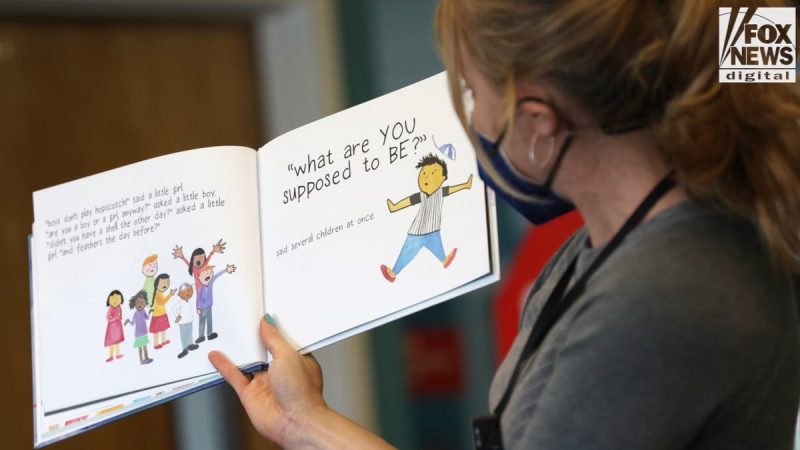
The Supreme Court heard arguments on Tuesday from religious parents who say young children can’t be expected to separate a teacher’s moral messages from their family’s beliefs – raising the question of whether exposure to LGBTQ-themed storybooks in elementary classrooms constitutes ‘coercion.’
Eric S. Baxter, the attorney representing Maryland parents in Mahmoud v. Taylor, told the justices that Montgomery County Public Schools violated the First Amendment by denying opt-out requests for books that ‘contradict their religious beliefs,’ even while allowing exemptions for other religious objections – such as books depicting the Muslim Prophet Muhammad.
‘There’s no basis for denying opt-outs for religious reasons,’ Baxter said during oral arguments. ‘Parents, not school boards, should have the final say on such religious matters.’
Justice Clarence Thomas asked Baxter about whether children were merely ‘exposed’ to the books or actively instructed by them.
‘Are the books just there and no more, or are they actually being taught out of the books?’ he asked.
Baxter said teachers were required to use the materials in class. ‘When the books were first introduced in August of 2022, the board suggested they be used five times before the end of the year. One of the schools, Sherwood School, in June for Pride Month said that they were going to read one book each day.’
Parents, supported by religious freedom organizations, argue that this policy infringes upon their First Amendment rights by compelling their children to engage in instruction that contradicts their religious beliefs. The Fourth Circuit Court, a federal appeals court, ruled last year that there was no violation of religious exercise rights, stating that the policy did not force parents to change their religious beliefs or conduct and that parents could still teach their children outside of school.
Justice Sonia Sotomayor asked Baxter whether exposure to same-sex relationships in children’s books could be considered religious coercion.
‘Is looking at two men getting married… is that the religious objection?’ she asked, referencing the book, ‘Uncle Bobby’s Wedding.’ ‘The most they’re doing is holding hands.’
Baxter maintained that it depends on the family’s faith. ‘Our parents would object to that,’ he said. ‘Their faith teaches… they shouldn’t be exposed to information about sex during their years of innocence without being accompanied by moral principles.’
Justice Samuel Alito inquired about the developmental capacity of young children as young as 4 to question classroom teachings and moral instruction.
‘Would you agree that there comes a point when a student is able to make that distinction?’ he asked. ‘That my teacher… isn’t necessarily going to be correct on everything. It is possible for me to disagree with him or her on certain subjects?’
Baxter agreed.
‘That’s right,’ he said. ‘And many of our clients’ objections would be diminished as their children got older.’
But Baxter stood strong on the point that age matters, especially in this case. He argued even Montgomery County school officials had acknowledged some books were not age-appropriate and criticized their attitude toward religious perspectives.
‘In a situation where Montgomery County’s own principals objected that these books were inappropriate for the age, they were dismissive of religion and shaming toward children who disagree,’ Baxter said. ‘The board itself withdrew two of the books for what it said were content concerns, because it finally agreed that what parents and petitioners – and its own principals – are saying was accurate.’
Mahmoud v. Taylor is one of three major religious cases the Supreme Court has on the docket for this year.
Earlier this month, the high court heard a case brought by a Wisconsin-based Catholic charity group’s bid for tax relief, which could alter the current eligibility requirements for religious tax exemptions.
At issue in that case is whether the Wisconsin branch of Catholic Charities, a social services organization affiliated with Catholic dioceses across the country, can successfully contest the state’s high court determination that it is ineligible for a religious tax exemption because it is not ‘operated primarily for religious purposes.’
The third case is about whether a Catholic online school can become the first religious charter school in the U.S.