
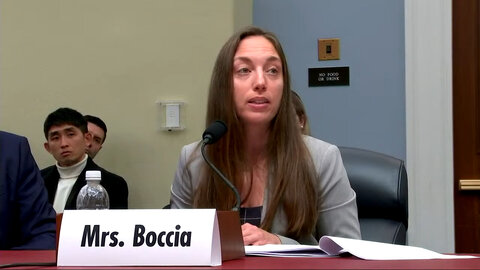
This morning, December 11, I’ll testify before the House Committee on the Budget at a hearing on “Sounding the Alarm: Pathways and Possible Solutions to the US Fiscal Crisis.” The Honorable David Walker (former Comptroller General of the United States), Kurt Couchman (Americans for Prosperity), and Dr. Douglas Elmendorf (Harvard Kennedy School of Government) will also testify as witnesses. You can watch the hearing live on C‑SPAN, YouTube, or the Committee’s website.
The United States is speeding toward a fiscal reckoning, and policymakers seem content to look the other way. How long can a government keep recklessly borrowing without facing the consequences? Not forever—and the bill is coming due. In my upcoming testimony, I’ll address the perilous trajectory of federal debt, which threatens to erode the foundations of economic prosperity, deepen inequality, and undermine national security.
Unchecked borrowing by the federal government doesn’t just live in the abstract world of fiscal spreadsheets and Congressional Budget Office projections. It crowds out private investment, hobbling entrepreneurs and businesses that drive innovation and job creation. It raises the specter of runaway inflation and leads the Federal Reserve down a dangerous path of debt monetization. And when a fiscal crisis hits, it’s not Washington politicians who will pay the highest price—it’s American families.
The writing is on the wall: this path is unsustainable. The warning signs are flashing red. Credit rating agencies have sounded the alarm—Fitch and S&P have downgraded US sovereign debt, and Moody’s has shifted its outlook to negative, citing political dysfunction and fiscal irresponsibility. These are not distant, academic concerns. They reflect a real and growing fear that elected officials are incapable—or unwilling—to chart a sustainable fiscal course.
And yet, Congress remains indecisive. The United States has become a textbook example of how democracies without strong fiscal rules succumb to persistent deficits. But it doesn’t have to be this way. Countries like Germany, Switzerland, and Sweden have shown that effective reforms are possible. With debt brakes and deficit limits, they’ve reined in unfunded spending and stabilized their budgets.
The way forward is clear. Congress should adopt a fiscal stabilization plan with enforceable goals, like achieving primary balance or stabilizing the debt-to-GDP ratio. Entitlement programs, primarily Medicare and Social Security, which account for the entirety of America’s long-term unfunded obligations, must be reformed. Political gridlock is no excuse—establishing a fiscal commission modeled on the successful Base Realignment and Closure (BRAC) process can help Congress adopt necessary changes.
Long-term solutions require structural change. That means institutionalizing fiscal discipline through mechanisms like a debt brake or a balanced budget amendment. And these tools must be flexible enough to account for emergencies or economic downturns. Fiscal rules work best when they have broad-based support, clear targets, and built-in mechanisms to accommodate crisis deficits while aiming for long-term balance.
The stakes couldn’t be higher. Failing to act will leave working Americans footing the bill for today’s excesses, with fewer opportunities and greater economic uncertainty. By committing to reform, Congress can safeguard prosperity and ensure America’s fiscal health as a robust base for economic growth. But time is running out. Will lawmakers rise to the challenge—or will they let the debt crisis define our nation’s legacy?