
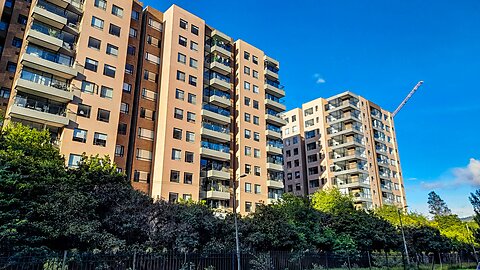
With tens of thousands of California residents living on the streets and widespread concerns over a housing affordability crisis, we might expect political leaders to build a large volume of new housing as quickly and inexpensively as possible. But, of course, that has not been the case. Thanks to a combination of special interest influence and the phenomenon of “everything bagel liberalism”, under which progressives try to solve a multitude of often-conflicting problems with one policy, California governments and their nonprofit partners have been creating housing very slowly and at a high cost. A better alternative is for governments to get out of the way and allow private entities to build low-cost housing quickly without the overhead of other political objectives.
How Not to Do It
In 2016, a fire originating from a neighboring building seriously damaged 3300 Mission Street, a building that housed 28 single-room occupancy (SRO) hotel units, two stores, and a bar. Although the owner originally planned to fix the building, he sold it to Oak Funds, a local real estate firm the following year. This firm also declared an intention to restore the SRO but never did so. These two owners may have been deterred from fixing the building because they would have been required to offer most of the units to their previous tenants who were covered by the city’s rent control ordinance. The fact that San Francisco obliged the owners to rent out much of the property at below-market prices may have made repairing the building uneconomic, especially given San Francisco’s high construction costs.
Last year Oak Funds sold the still vacant building to affordable housing developer Bernal Heights Housing Corporation (BHHC) for $1 million more than it paid for the property in 2017. Since then, BHHC has been assembling financing to rebuild and expand 3300 Mission, albeit at a high cost to taxpayers.
Under a plan recently approved by San Francisco supervisors, BHHC will spend $41 million (including the already incurred acquisition cost) to produce 35 units: residential units, a community space, and a small retail space. The cost per residential unit works out to be about $1.1 million each, even though all the units will be small studios ranging in size from 267 to 406 square feet.
One reason that the project is so expensive is that San Francisco requires construction workers building the affordable housing projects it funds to be paid so-called prevailing wages determined by the California Department of Labor Relations. This means that construction laborers must receive a salary and benefits package worth $69.41 per hour on weekdays, with large premiums for Saturday and Sunday work.
Although construction costs themselves are high, there are other drivers for the high price of these units. The project budget includes $3.3 million in construction financing costs, $2.6 million in developer fees, $2.2 million in architect fees, and $590,000 in legal fees, so a range of professionals are being well compensated.
BHHC will receive $16.6 million of city funds covering 40 percent of overall project costs. The rest will be privately funded by investors taking advantage of a 9 percent Low Income Housing Tax Credit (LIHTC). This credit allows the investor to exclude 9 percent of project cost annually for each of the ten years after which the building is completed. The credits can also be bought and sold on the secondary market. The Tax Foundation has characterized LIHTC as “an exceptionally complex tax expenditure.”
Occupancy is now expected in late 2026, ten years after the original building became uninhabitable. And the City Attorney has determined that rent-controlled tenants living in the building before the fire will no longer have a right to return.
A More Efficient Option
While government-funded projects typically require on-site construction with laborers receiving prevailing wages, private affordable housing projects can rely on lower-cost prefabricated units. Two miles north of 3300 Mission at 33 Gough Street, nonprofit Dignity Moves created a 70-unit tiny home village. Construction began in January 2022 with occupancy occurring six months later. The cost per unit, including shared amenities, worked out to $32,000.
The homes do not include separate kitchens or bathrooms, but, as Dignity Moves CEO Elizabeth Funk recently told me, sharing dining and washing facilities is not a major issue for most individuals experiencing homelessness. More important to them is having a roof over their heads in a unit that can be locked.
The 33 Gough tiny home village is one of several “interim supportive housing” projects Dignity Moves has completed or is developing in California. These projects provide services such as life coaching and addiction treatment, in addition to the homes themselves. While the lifespan of the tiny homes is likely shorter than permanent supportive housing units, they are less expensive to maintain, insure, and replace.
Some government officials are embracing interim housing, including San Jose Mayor Matt Mahan. His city plans to have about 1,300 interim units available by the end of 2024. The California state legislature has also gotten into the act, recently passing a bill exempting tiny home villages from the California Environmental Quality Act (CEQA) process.
It remains to be seen whether more government involvement in the creation of tiny home villages will slow their completion and increase their costs. Hopefully, tiny homes will not become the schmear on the everything bagels so often baked by California’s public sector.