
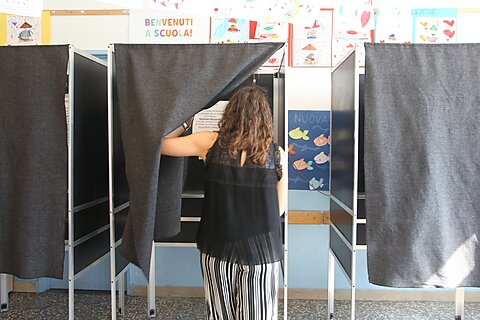
On August 8, as part of a day of election law panels at the National Conference of State Legislatures’ annual legislative summit, I spoke on proposals to toughen existing laws against voting by noncitizens. I discussed the Safeguard American Voter Eligibility Act (SAVE Act), widely seen as a Republican messaging bill that’s dead in the current Senate. As far as I can see, the bill—passed by the House on July 10 on a largely party-line 221–198 vote— starts with a couple of reasonable ideas and then runs aground on the details.
Most commentary on the bill has taken an all-or-nothing approach. Critics have damned it as the product of “xenophobia” and as legislation that “seeks to intimidate members of immigrant communities and communities of color from exercising their lawful right to vote.” They have also pointed out, in my opinion correctly, that current rates of illegal noncitizen voting appear too low to have changed any federal election outcome in any state over the past generation. On the other side, gadfly tycoon Elon Musk declared that those who oppose the bill are “TRAITORS”: “What is the penalty for traitors again?” That was sure to calm everyone down right quick.
The bill’s main provision prohibits states from registering an individual to vote in a federal election who does not provide documentary proof of US citizenship at the time (bill summary; one-pager in support by sponsor Rep. Chip Roy (R‑Tex.); analysis and critique from House Democrats).
Currently, federal laws on voter registration passed in 1993 and 2002 prohibit states from coming up with their own rules for how much proof of citizenship is enough to register, at least for federal elections. Some states would like to use stronger rules, and the area has been much litigated.
In best Washington style the SAVE Act replaces the prohibition on state use of tougher standards with a requirement that they use them.
The bill does have one other idea worth exploring. Federal agencies themselves have some of the best data about who is and isn’t a citizen. But as a Bipartisan Policy Center task force has found, states currently complain that accessing federal citizenship data is “difficult, costly, and burdensome.” The bill promises fixes to assure more access—the sort of measure that might in principle be carved off as a freestanding bill for separate consideration.
Even if database matching improves, the fact is that it’s hard for much of the population to lay hands on high-level documentary proof of citizenship. Drivers’ licenses, government employee IDs, and the like generally don’t record citizenship status. Passports are better, and so are domestic birth certificates bearing someone’s current legal name, but much of the population cannot easily lay hands on either, especially given that many married women have changed their legal names.
For all the polarized talk in this area, the SAVE Act itself acknowledges that less-than-perfect compromise solutions would be necessary. It “requires states to establish an alternative process under which an applicant may submit other evidence to demonstrate US citizenship.” Will this involve some combination of second-best documents, sworn attestations, in-person interviews, or maybe something else? The bill is sparse and vague on these crucial details. Instead, it empowers a henceforth obscure federal agency, the Election Assistance Commission, to begin issuing guidance to states on how to apply the law.
As for the rest of the bill, as critics have noted, it bristles with punitive enforcement provisions and unrealistic timelines. Beyond that, there are intrinsic dangers under our constitutional scheme—as Republicans would once have been first to warn—in letting the federal government build discretionary regulatory power over local election administration.
Don’t be afraid to ignore the rants from Musk and his opposite numbers, and mark this one as “needs more work— come back in a non-election year.”