
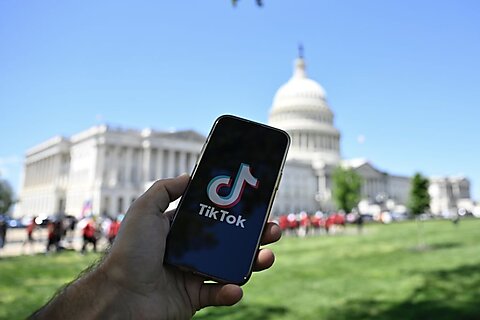
In April, President Biden signed an unprecedented law that required TikTok to either “divest” from its parent company ByteDance by January 2025 or cease operations in the United States. Such divestment would likely be infeasible because ByteDance owns much of TikTok’s code and employs many of the engineers who make TikTok run. And even if it were feasible, American TikTok users would lose access to content from outside the country, fundamentally changing the platform.
The law contained an unusual provision requiring that any legal challenges be brought directly in the US Court of Appeals for the DC Circuit, bypassing the federal district courts. Pursuant to that requirement, three lawsuits have been brought in the DC Circuit challenging the law, one by TikTok itself and two by various TikTok users. And Cato has now filed an amicus brief in the DC Circuit supporting these challenges.
In our brief, we address two justifications for the law that were repeatedly invoked by lawmakers: that TikTok is a platform for “propaganda” and that it is a platform for “misinformation” and “disinformation.” As our brief explains, neither of these arguments can justify the law, because there is no First Amendment exception for either “propaganda” or false speech.
The TikTok divestment bill is not the first time Congress has enacted a bill infringing on speech rights to combat foreign “propaganda.” In the 1960s, members of Congress used strikingly similar rhetoric to that used by lawmakers today when they passed a similar bill. That 1960s law mandated screening of incoming foreign mail for “Communist political propaganda.” If a government official determined that a piece of mail contained such propaganda, the mail would only be delivered if its intended recipient promptly returned a form affirmatively requesting its delivery.
The Supreme Court rightly struck down this “Communist propaganda” law in Lamont v. Postmaster General (1965). As the court explained, the “Communist propaganda” law was “at war with the ‘uninhibited, robust, and wide‐open’ debate and discussion that are contemplated by the First Amendment.” As the court later reaffirmed in Hustler Magazine v. Falwell (1988), “the ultimate good desired is better reached by free trade in ideas … the best test of truth is the power of the thought to get itself accepted in the competition of the market.” If the government disagrees with speech that it views as harmful “propaganda,” the government can use its own voice to rebut that speech. But the government does not have the power to censor or burden disfavored views. It is up to the people to decide which ideas win out.
Nor can the government justify censorship on the grounds that it is merely fighting falsehoods. In United States v. Alvarez (2012), the Supreme Court struck down a law criminalizing false claims of having won a military medal. As Justice Anthony Kennedy explained, “our constitutional tradition stands against the idea that we need Oceania’s Ministry of Truth.” Instead, “the remedy for speech that is false is speech that is true. This is the ordinary course in a free society. The response to the unreasoned is the rational; to the uninformed, the enlightened; to the straight‐out lie, the simple truth.”
Placing the power to arbitrate the truth in the hands of the government would be dangerous, both because government officials make mistakes and because they can be motivated to suppress disfavored speakers, using falsehoods only as a pretext. Such motivation may well have been behind Congress’s choice to single out TikTok and not address other social media sites with comparable levels of “misinformation.”
As our brief notes, non‐content‐based concerns over hacking and data‐tracking could hypothetically justify government action against a platform, but the government has not proffered public evidence that meets the burden necessary to support this justification either. Congress has targeted TikTok because of the viewpoints it carries (or that it is perceived to carry). That is a core First Amendment violation, and the DC Circuit should block the law from taking effect.